

Whenever AI infrastructure is discussed, especially with reference to GPUs, many prominent conversations center around GPUs since GPU plays a vital role in AI systems. Having said that, modern AI systems do not rely only on one type of processor for their operation.
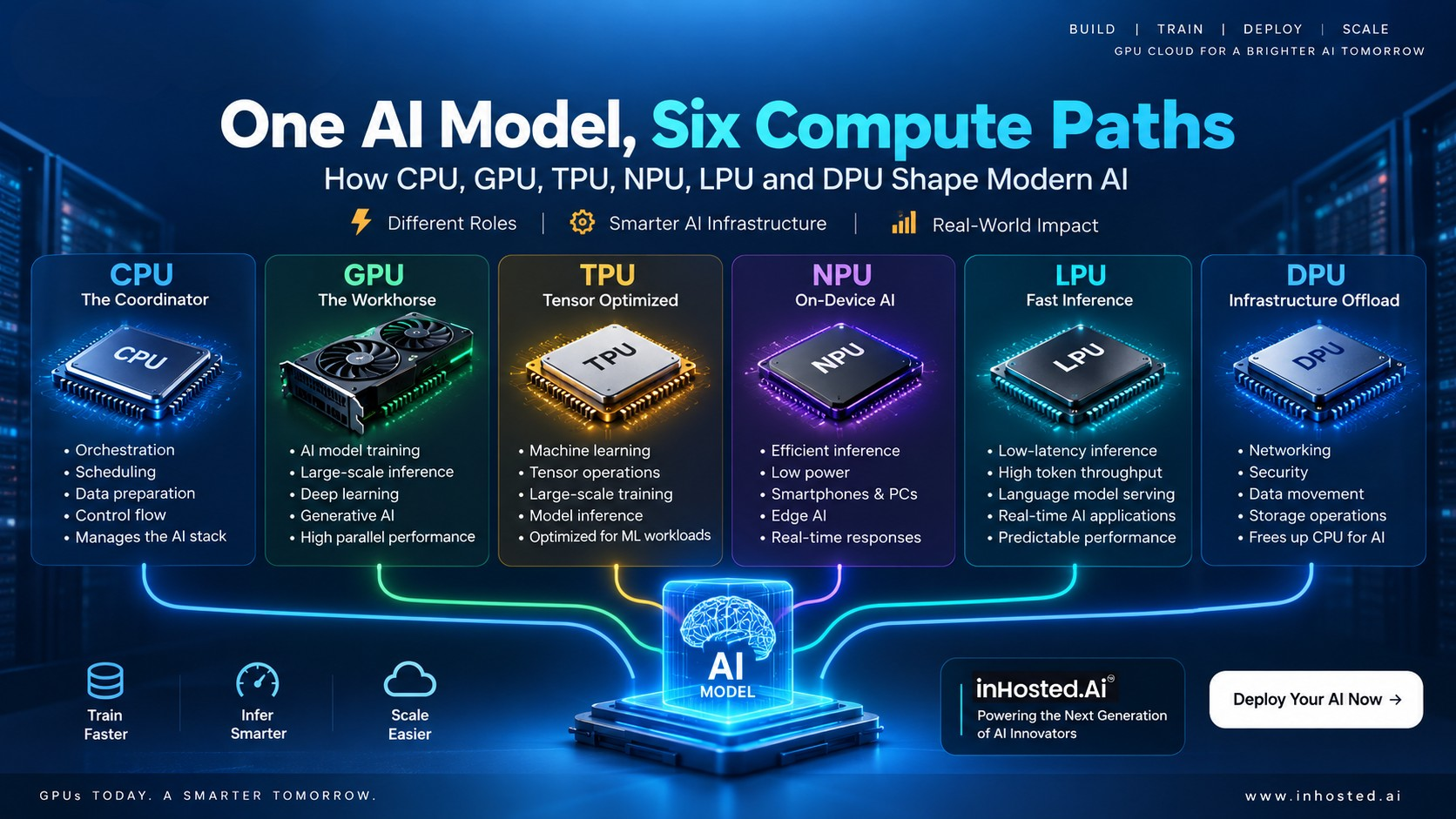
Modern AI systems use different types of computing devices that are designed for specific tasks. For example, CPUs are in charge of coordinating tasks and managing data, GPUs handle complex calculations, TPUs enable machine-learning tasks and NPUs help to perform AI processing on the device. Moreover, specific processing devices, like LPUs, are capable of processing low-latency language-modelling operations.
All these devices create an efficient model for AI computing in different environments.
Which means that in order to understand how they differ from each other, it is important to learn about how each device is used in practice.
Why Does AI Need Different Types of Processors?
Not every AI workload has the same requirements.
Training a large model needs a lot of computation and data. Using that model to serve a user represents a different challenge, where latency and throughput might come into play. Running an AI application on a laptop or smartphone introduces constraints on power consumption and thermal consumption. At the data center level, networking and data movement impose other kinds of requirements.
Thus, using the same processor for any task leads to unnecessary compromises.
This is the reason why modern AI infrastructure is growing increasingly heterogeneous. Rather than depending on a single processor to do everything, systems can combine general-purpose CPUs with special accelerators and infrastructure processors.
1. CPU: The Coordinator
The central processing unit (CPU) is a fundamental part of an AI system.
CPUs can perform various functions and are designed to conduct multiple tasks without necessarily excelling in any given one of them. In the context of AI, CPUs handle complex functions such as application logic, scheduling, data preparation, OS functions, and communication between other elements.
In this regard, the CPU can be referred to as a coordinator.
For instance, when an AI software receives a user inquiry, it prepares input data. The CPU sends the task that requires intensive computations to a GPU or other accelerator. While the accelerator is working, the CPU continues to process the rest of the application.
This makes CPUs a necessary component of AI servers, regardless of the fact that they are not the ones executing heavy computations.
2. GPU: The Parallel Processing Workhorse
The Graphics Processing Unit (GPU) is regarded as one of the most popular hardware for accelerating AI and machine learning processes.
GPUs are good at performing parallel processing. This makes them suitable for performing matrix and tensor operations typically required in AI processing.
Some of the applications of GPUs include
– Training of AI and machine learning
– Performing inference at scale
– Use of generative AI
– Deep learning tasks
– Computer vision
– Scientific computing
– Fine-tuning of models
Another important benefit of using GPUs is flexibility. GPUs can take on many types of workloads and are not limited to a certain kind of application.
This is among the reasons for the popularity of GPU cloud infrastructures among AI teams. Companies no longer have to buy or maintain expensive hardware but may rent GPU computing power on demand and increase their computing capacity as needed.
3. TPU: Specialized for Machine Learning
A Tensor Processing Unit (TPU) employs a more specialized method of AI acceleration.
TPUs were specifically created by Google for speeding up machine-learning tasks and are constructed using certain architecture that supports activities used in neural networks.
TPUs are useful for:
- Machine-learning training
- Tensor-heavy tasks
- Large-scale AI platforms
- Analysis of models
- Cloud-based machine learning activities
The main distinction is specialization.
On one side, a GPU is a versatile accelerator that can be utilized in many parallel processes. On the opposite side, a TPU is tailored for machine-learning processing and is linked to Google’s software and cloud ecosystem.
In organizations where TPU workloads can be carried out, this feature is beneficial.
4. NPU: Bringing AI to the Device
A NPU, also referred to as a Neural Processing Unit, is aimed at speeding up the execution of AI workflows on devices like mobile phones, laptops and other edge computing devices.
The point is that, instead of transferring all AI processes to a remote facility, one can perform some functions on the device itself.
NPUs may be utilized for:
- Voice recognition
- Image processing
- Computer vision
- AI assistants
- Generative AI models
- Inference
The main benefit of NPUs is their efficiency.
Since AI processes are implemented locally, it means decreased dependency on cloud connections and quicker actions, which limit the devices’ power and thermal capabilities.
5. LPU: Designed Around Fast Language-Model Inference
LPU stands for Language Processing Unit and is usually related to designs like the one used in Groq’s Language Processing Unit.
In contrast to an ordinary processor, LPU is built specifically for language models’ processing tasks such as inference.
This means it can be widely used in applications where:
- Lower latency
- Fast token production
- Consistent times of response
- High efficiency in inference
are necessary.
That said, it is not correct to refer to LPU as a replacement of GPU.
GPUs are very flexible and suitable for training, inference, and other speeded applications. Specialized processors for inference are designed to solve a different optimization task.
The needed equipment may vary based on the requirements of the system where it is intended to be used.
6. DPU: Moving Infrastructure Work Away From the CPU
The Data Processing Unit (DPU) serves a uniquely different function compared to other processors in the above list.
The DPU is primarily used to help accelerate infrastructure tasks like networking, security and data movement.
As AI becomes more widespread, the importance of this function increases.
In a large-scale AI environment, data is constantly passed back and forth between CPUs, GPUs, storage systems and other machines. All these tasks managed by the CPU consume resources that might ideally be used by applications.
So, DPUs can assist in relieving some of that operational burden and making the overall process of operation more efficient.
CPU vs GPU vs TPU vs NPU vs LPU vs DPU
| Processor | Primary Role | Typical AI Environment |
|---|---|---|
| CPU | General-purpose computing and orchestration | Servers, cloud and applications |
| GPU | Parallel AI and compute workloads | AI training, inference and HPC |
| TPU | Specialized machine-learning acceleration | Supported cloud ML workloads |
| NPU | Efficient AI processing | Smartphones, PCs and edge devices |
| LPU | Specialized language-model inference | Low-latency AI serving |
| DPU | Infrastructure and data movement | Data centers and AI infrastructure |
The important point is that these aren’t necessarily competing technologies.
In many cases, they complement each other.
How Can These Processors Work Together?
Think about a scenario where an AI application gets an order coming from its user.
The CPU might have the task of executing the processing flows and managing the orders. The actual model computations might be delegated to GPU or other type of needed hardware used in computation. If the app is functioning on its own system, NPU could take care of the local computations. Also, there could be inference devices aimed at reducing the latency.
At the level of the infrastructure, DPU takes care of processing and distributing the data.
As a result, there is not one processing device that does everything, but a system of specialized processing devices working together.
Do You Need a GPU, TPU, NPU or LPU for AI?
It all depends on the job at hand.
For training large AI systems, GPUs are generally the preferred choice because they can handle large amounts of parallel processing efficiently as well as being fully compatible with most other software systems.
If you are using a machine-learning system set up to work with TPUs, then it would be justifiable to think about this type of processor.
If you are developing AI capabilities for usage in mobile phones, computers, or embedded systems, then you may find an NPU productive.
If you just need a responsive language-processing system, then it makes sense to go for some special-purpose processor for inference.
When building large-scale AI hardware, you should probably think about DPUs since they can solve the networking and data-related problems that come along with computer hardware.
What Does This Mean for Businesses?
When it comes to businesses utilizing artificial intelligence, the choice of infrastructure isn’t only about picking a powerful chip. The following must also be considered:
- Model size
- Requirements for training/inference
- Memory capacity
- Latency requirements
- Throughput
- Software compatibility
- Scalability
- Infrastructure costs
Most of the time, GPUs remain a viable option for many AI workloads, as they provide a combination of high performance, flexibility, and extensive ecosystem support.
GPU cloud infrastructure can make this easier for businesses that do not want to have to either build their own GPU servers or maintain them. Teams can simply have access to the computing power needed for AI training, inference, fine-tuning, and other workloads without building a physical infrastructure from scratch.
The Future of AI Compute Is Specialized
The most significant transformation occurring in AI infrastructure is not about switching from one microprocessor to another microprocessor. It is all about the emergence of more specialized types of AI computing.
Central processors are made for general control. The GPU is designed for very intensive parallel computation. TPUs are specifically made for machine learning process. NPUs bring AI to the devices. LPUs and other special accelerators are aimed at solving very targeted inference problems and DPUs can be used in managing the interlink between various systems.
This means that the future of AI will not hinge on locating one chip type suited for every task. Future success will be defined by the ability to work on finding the exact mix of computing resources suitable for a certain task.
For organizations actively investing in AI, understanding that opportunity is the key to distinguishing between just having compute and having the computing atmosphere that is able to withstand any needs of AI computing.