Artificial intelligence has entered a new phase where massive AI models are capable of solving complex tasks such as language understanding, coding, data analysis, and content creation. At the heart of this transformation are foundation models, a new class of AI systems trained on enormous datasets and designed to perform multiple tasks.
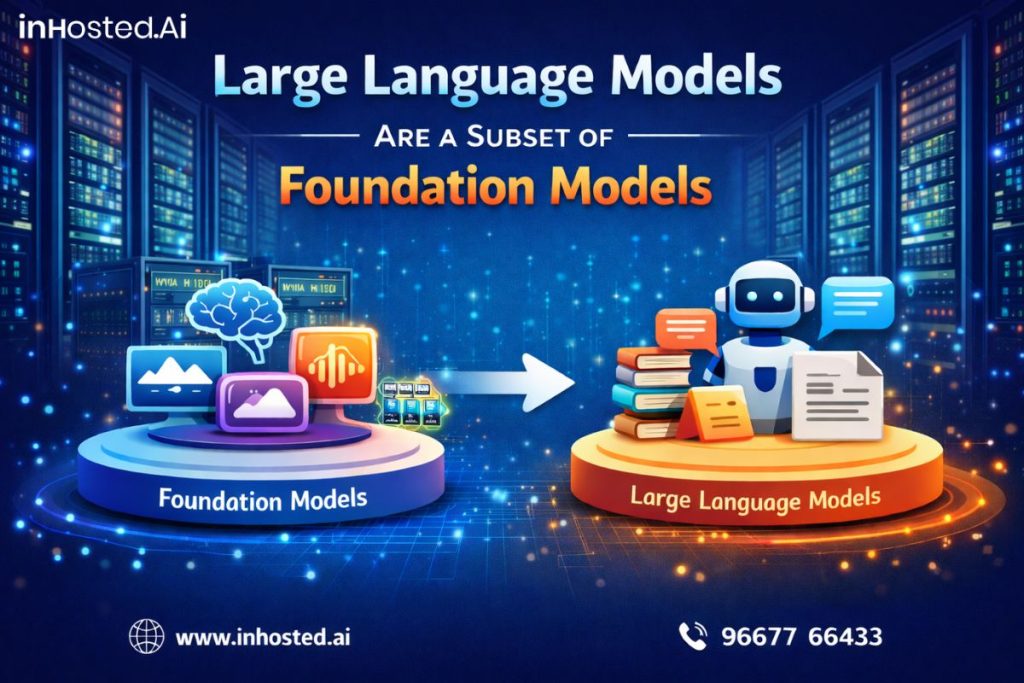
Within this broad category, large language models are a subset of foundation models. While foundation models may process images, audio, and multimodal data, large language models specialize in understanding and generating human language.
Today, organizations building AI products—from startups developing chatbots to enterprises building data-driven platforms—depend heavily on large language models. Running and training these models requires powerful AI infrastructure, including GPU cloud platforms like inhosted.ai, which provide on-demand access to high-performance GPUs for AI training and inference workloads.
Understanding the relationship between foundation models and large language models helps businesses adopt AI more effectively and build scalable AI applications.
Introduction Large Language Models Are a Subset of Foundation Models
Artificial intelligence used to rely on highly specialized models designed for individual tasks. For example, one model might recognize images while another translated languages.
However, the rise of foundation models in AI has fundamentally changed how modern AI systems are built.
Instead of creating separate models for every problem, developers now train large general-purpose models capable of handling multiple tasks. These models can then be fine-tuned for specific use cases such as chatbots, recommendation engines, or document analysis.
This new approach has enabled rapid innovation in areas like
- conversational AI
- automated research tools
- AI-generated content
- real-time analytics
- enterprise automation
Among these technologies, large language models have become the most widely adopted because they enable machines to interact with humans using natural language.
But to understand their role, we first need to explore what foundation models actually are.
What Are Foundation Models in AI
Foundation models in AI are large-scale machine learning systems trained on massive and diverse datasets. These models serve as the base architecture that supports multiple AI applications.
Once trained, they can be adapted to perform different tasks without building a new model from scratch.
Key Characteristics of Foundation Models
- Massive Training Data: Foundation models are trained on huge datasets containing text, images, audio, or code.
- Adaptability: These models can be fine-tuned to support multiple downstream applications such as chatbots, recommendation engines, and AI analytics.
- High Computational Demand: Training these models requires powerful computing infrastructure, including distributed GPU clusters.
Modern AI platforms provide cloud-based GPU environments that allow teams to train and deploy foundation models faster without investing in expensive hardware.
Platforms like inhosted.ai enable developers and enterprises to spin up powerful GPU instances in seconds, allowing AI workloads to scale rapidly.
What Are Large Language Models
To understand how AI language systems work, we first need to answer a key question: what are large language models?
Large language models are AI systems trained on massive text datasets that enable machines to understand and generate human language.
Because they focus specifically on language tasks, large language models are a subset of foundation models.
How Large Language Models Work
Large language models use deep neural networks—often built using transformer architecture—to learn patterns in language.
During training, the model analyzes billions of words and learns relationships between them. This allows the system to predict and generate coherent responses in context.
Once trained, large language models can perform tasks such as:
- answering questions
- summarizing documents
- generating articles
- writing code
- translating languages
However, training these models requires extremely high computational power, which is why modern AI teams rely on GPU cloud infrastructure.
LLM vs Foundation Model
Many people confuse LLMs with foundation models, but the difference is simple.
A foundation model is a general AI architecture, while large language models are a specific category focused on language tasks, such as text generation, translation, and summarization.
| Feature | Foundation Models | Large Language Models |
|---|---|---|
| Definition | General-purpose AI models trained on massive datasets | AI models focused on understanding and generating human language |
| Data Types | Text, images, audio, and multimodal data | Mainly text data |
| Applications | Vision AI, speech recognition, generative AI | Chatbots, content generation, translation |
| Scope | Broad category of AI models | Subset of foundation models |
So while all large language models are foundation models, not every foundation model is a language model.
Types of Foundation Models
Foundation models come in several different forms depending on the type of data they process.
1. Language Models
Language models are responsible for processing text data. This category includes large language models used in chatbots, digital assistants, and AI writing tools.
2. Vision Models
Vision models analyze images and videos. They are widely used in healthcare diagnostics, autonomous vehicles, and security systems.
3. Multimodal Models
Multimodal models combine multiple data types such as text, images, and audio. These models can understand different types of information simultaneously.
4. Generative AI Foundation Models
Generative AI foundation models can create entirely new content, including text, images, videos, and audio.
These models are powering many modern AI platforms and enterprise automation systems.
Why Large Language Models Matter for Businesses
Businesses are rapidly adopting large language models because they enable automation and smarter decision-making.
Customer Support Automation
LLMs can power AI chatbots that respond to customer queries instantly.
Content Creation
Companies use large language models to generate marketing content, documentation, and reports.
Data Analysis
LLMs can analyze large datasets and summarize insights quickly.
Enterprise Productivity
Organizations are integrating large language models (LLMs) into internal systems to automate workflows and knowledge management. LLMs are advanced AI systems that can understand and generate human-like text.
However, deploying these AI systems requires robust infrastructure capable of handling heavy computational workloads.
Infrastructure Needed to Train LLMs
Training large language models requires extremely powerful computing infrastructure.
GPU-Accelerated AI Infrastructure
Modern AI workloads rely heavily on high-performance GPUs such as the NVIDIA H100 GPU and NVIDIA A100 price systems, which provide massive parallel computing power for deep learning tasks.
Platforms like inhosted.ai allow AI teams to access powerful GPUs such as H100, A100, and other accelerators on demand, enabling faster AI training and scalable deployments.
Cloud GPU Advantages
Using cloud GPU platforms offers several advantages:
- instant GPU deployment
- scalable compute clusters
- pay-as-you-go pricing
- no hardware maintenance
GPU cloud environments enable developers to run AI training jobs faster while reducing infrastructure complexity.
Future of Foundation Models and LLMs
The future of artificial intelligence will continue to be shaped by foundation models and large language models.
Researchers are now exploring:
- more efficient training methods
- multimodal AI systems
- smaller yet more powerful models
- scalable AI infrastructure
As AI adoption grows, businesses will require flexible GPU cloud platforms that allow them to build, train, and deploy models at scale.
This is why AI infrastructure providers such as inhosted.ai are becoming increasingly important for organizations building next-generation AI solutions.
Conclusion
Artificial intelligence is evolving rapidly, and understanding its core technologies is essential for businesses and developers.
Foundation models provide the base architecture that powers modern AI systems. Within this ecosystem, large language models focus specifically on language understanding and generation.
Recognizing that large language models are a subset of foundation models helps clarify how modern AI is structured and why it is transforming industries worldwide.
As AI models continue growing in complexity, scalable GPU cloud infrastructure will remain critical for training, deploying, and managing these powerful systems.
FAQs
1. What are foundation models in AI?
Foundation models are large machine learning models trained on massive datasets that can be adapted for multiple tasks such as language processing, image recognition, and generative AI.
2. Why are large language models a subset of foundation models?
Large language models focus specifically on natural language processing, making them one category within the broader foundation model architecture.
3. What are large language models used for?
Large language models are used for chatbots, document summarization, content generation, code writing, and language translation.
4. Why do large language models require GPUs?
Training large language models involves massive neural networks and datasets, which require high-performance GPUs to process computations efficiently.
5. How does GPU cloud help train AI models?
GPU cloud platforms provide on-demand access to powerful GPUs, enabling faster AI model training and scalable deployment without requiring expensive hardware.
6. What is cloud storage for education, and how does it support AI and research workloads?
Cloud Storage for Education provides scalable and secure storage designed for universities, research labs, and learning platforms. It allows institutions to store large datasets, research files, and AI training data while enabling easy collaboration, fast access, and reliable backup for data-intensive workloads.